



Dawn Patrol vs. Sunset Session: Picking Your Window on the Water
Every rider eventually develops a favorite time of day on the water. Some swear by the glassy calm of first light, while others live for the warm, golden hours before sunset. The truth is that both windows offer genuinely different experiences, and understanding what each one gives you can transform how you plan your sessions.
Dawn sessions often mean lighter, more consistent breeze. As the land cools overnight, the temperature difference that drives coastal wind is at its weakest, so you're often dealing with the tail end of whatever gradient wind is present. That can be frustrating if you're chasing big numbers, but it's a gift for foilers, longboard sailors, and anyone learning to kite in calmer conditions. The water is flat, the launch ramps are empty, and the whole experience feels meditative.
Evening sessions are a different animal entirely. By late afternoon, the sun has been baking the land for hours, and the thermal cycle is often at full throttle. This is when the classic seabreeze builds to its peak, delivering the punchy, steady wind that most riders dream about. The trade-off is crowds—every kiter, windsurfer, and sailor in the area tends to converge on the same launch at the same time, which means navigating right-of-way rules and dodging other people's lines.
What Your Local Spot Actually Does
Generic advice about morning versus evening only gets you so far. The real answer depends on your specific launch. A spot with a long fetch and a strong thermal setup might be dead at dawn and firing by 3 p.m. A sheltered bay with offshore morning breeze might be perfect at 7 a.m. and dangerous by noon as the wind shifts cross-shore.
Spend a few weeks logging what you actually observe. Note the time, the wind direction, the strength, and how it felt on the water. Patterns emerge quickly. You'll start to see whether your home spot rewards early risers or rewards patience. You'll also learn which days are worth calling in sick for and which ones you can safely skip.
Reading the Forecast Beyond the Numbers
Most forecast apps give you a wind speed and direction, but they rarely capture the nuance of a thermal cycle. A forecast showing 15 knots at noon might be dead calm at 9 a.m. and howling at 4 p.m. Pay attention to how the forecast evolves hour by hour, not just the daily peak. If you see the numbers ramping through the afternoon, that's a thermal signature. If they're flat all day, you're relying on gradient wind, which is often more consistent but less powerful.
Temperature also matters more than most people realize. A day with a big spread between air and water temperature is more likely to produce a strong seabreeze. A day where everything is uniformly warm or uniformly cool tends to be softer. Combine that with cloud cover—too many clouds kill the thermal, too few can make it explosive—and you start to build a mental model that's far more useful than any single number on a screen.
Ultimately, the best window is the one that matches your goals. If you want to practice freestyle in flat water with few distractions, dawn is your friend. If you want to push your speed and ride powered up, the afternoon thermal is hard to beat. Most riders end up doing both, depending on the day, the forecast, and how much energy they have. There's no wrong answer, only different flavors of the same obsession.


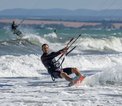


Early birds and evening chasers get different winds, different crowds, and different rewards—here's how to choose your slot.
Light wind doesn't have to mean a wasted day—here's how to keep progressing when the breeze won't cooperate.
Thunderstorms, fronts, and squalls create both hazards and opportunities—here's how to read the sky and stay safe.
The surface of the water is a constantly updating forecast—here's how to interpret what you're seeing.
Riding with others accelerates your learning, keeps you safe, and makes every session more fun.